Science by majority
Cosmology plainly doesn’t work by consensus, but when does in-fighting become unhealthy?

From the outside, science can seem to offer serene progress, carrying us from ignorance through a few curious mysteries towards complete understanding, a destination that can only be reached through consensus among researchers, all pulling in the same direction.
But the closer you examine your subject, the more complex it can become, offering nuance and new contradictions at every turn. Even when it comes to the biggest questions of all, already contemplated by great minds for centuries or millennia - the nature of the smallest particles and the largest celestial objects, the mechanics of unseen forces, even how the universe itself was created.
Surely all of this is pretty much worked out, the target of some of the biggest brains and the thickest wallets this planet has ever produced? Maybe not.
A recent survey of American Physical Society readers found significant discordance with some of the most well-funded fields in physics, including string theory and the search for dark matter.
And despite initial concern the results could have been unbalanced by a large number of ‘science enthusiast’ responses, fresh analysis1 of the original survey data for this newsletter shows the disagreement is largely between professional researchers, rather than people operating outside science.
All of which draws the question - is such a level of disagreement healthy, even essential, or is it detrimental to the ideal course of scientific exploration and discovery?
“I think the big surprise was the lack of consensus,” said Professor Niayesh Afshordi, lead author of the resulting paper, whose work spans cosmology, gravity and quantum physics. “The areas where there might seem to be consensus or majority opinions, they were far from it”.
In particular he highlights string theory and dark matter as areas of strong disagreement among 1,675 respondents to the open APS survey.
“We all live in our own bubbles and we don’t hear the contrary or contrarian opinions,” added Afshordi. “The whole consensus-building thing. Maybe we don’t need consensus building, complete consensus. But what is a healthy level of scepticism and in-fighting?”
Since the 1990s string theory has dominated fundamental physics, the search for the building blocks of our reality, but the survey showed limited support for how useful it might still be.
String theory (also known by the umbrella term M-theory) is sometimes tethered to the multiverse concept, which envisions unlimited dimensions in which all things occur (and which, by definition, would require the involvement of Benedict Cumberbatch in at least some of them). In fact, most versions of string theory rely on our universe having six extra dimensions, while M-theory requires seven.
So is string theory the best way to unify the theories of gravity and quantum mechanics, perhaps the biggest question looming over physics today? Only 19 per cent of respondents agreed2.
“I think that’s striking,” said Afshordi. “If you were to ask me what is the actual number, before the survey? I would have said maybe twice as many as that.”
Such a divide in opinion could pose serious dilemmas for new scientists trying to decide the best subjects to study. If string theory still dominates funding, but practitioners are unsure of its value, should they really be studying something else?
“If you’re a young person and you want to work on the most promising or deepest theory of nature, it looks like you have to work on string theory,” said Afshordi. “Because if you work on anything else, even though there are lots of ideas out there, it’s really hard to secure a job.”
“If we are making decisions wisely, we have to think about how we could bring or recruit young people in a way that encourages young people to think about out-of-the-box ideas as opposed to joining big groups. If they are forced to conform, then we are kind of losing maybe our most precious resource, which are fresh ideas.”
These aren’t just quandaries for new scientists, but for any government spending public money on research on once fashionable subjects that start to fall out of favour. And it’s a question that extends to the search for dark matter, an invisible substance that is thought to hold our universe together, responsible for galaxy formation and creating the conditions for the emergence of planets.
Dark matter was conceived of a century ago to solve the ‘gravity anomaly problem’, but the underlying mystery persists. Massive celestial bodies, like planets and stars, generate gravity which can hold other bodies in orbit. But nearby galaxies didn’t have enough stars to generate the gravity that would be needed to hold them together.
Add in enough invisible matter, and the galaxy problem is solved. But no-one searching for a dark matter particle has yet found one - while alternative explanations, like modifying our basic understanding of gravity, have slowly gained traction, as shown in the survey. Twelve per cent of respondents backed one such theory, Modified Newtonian Dynamics, or MOND, while only 10 per cent said the lead contender for a dark matter particle - a relatively high-mass particle called a WIMP - was likely to provide the answer.
“Essentially it was just the roll of a die,” said Afshordi. “This idea of testing dark matter, I mean, we’ve been looking for it for the past 40 years and we haven’t found it. So then the question is, okay, so do we keep doing this or at what point do we give up? We have substantial gravitational evidence for dark matter. What we lack is a confirmed direct, non-gravitational detection of a dark-matter particle.”
That particle discovery relies on a handful of ongoing detection projects around the world including CERN, the world’s largest particle collider, and is a stated objective for its successor, the $19 billion Future Circular Collider.
The tensions between dark matter and MOND, as competing explanations for gravity anomalies, seem likely to rumble on if a dark matter particle remains elusive, and as new observations challenge long-accepted notions of how our universe functions.
But Afshordi worries that the momentum built up by vast research projects, like the dark matter detection effort and particle colliders, could be hard to stop.
“It’s kind of a self-fulfilling cycle,” he said. “We need some healthy mechanisms to keep us from these too-big-to-fail industries. That’s the problem, if you have thousands of people working in this industry, you cannot just shut it down because then suddenly thousands of people become jobless. You can, but it’s just kind of catastrophic.”
Afshordi suggests splitting funding or research time between the big ideas and outliers, to cultivate what could be seen as a kind of constructive, well-ordered in-fighting.
“If you spend 50 per cent of your time or funding on large machines, like a Large Hadron Collider or on big dark matter experiments, then maybe you should spend 20 per cent on niche things, things that are not supported by the majority, things that are more kind of fringe ideas.”
“Part of it is, okay, is this thing that we’re funding, does anybody believe in it? That’s probably something good for a taxpayer, or for people in power, to know.”
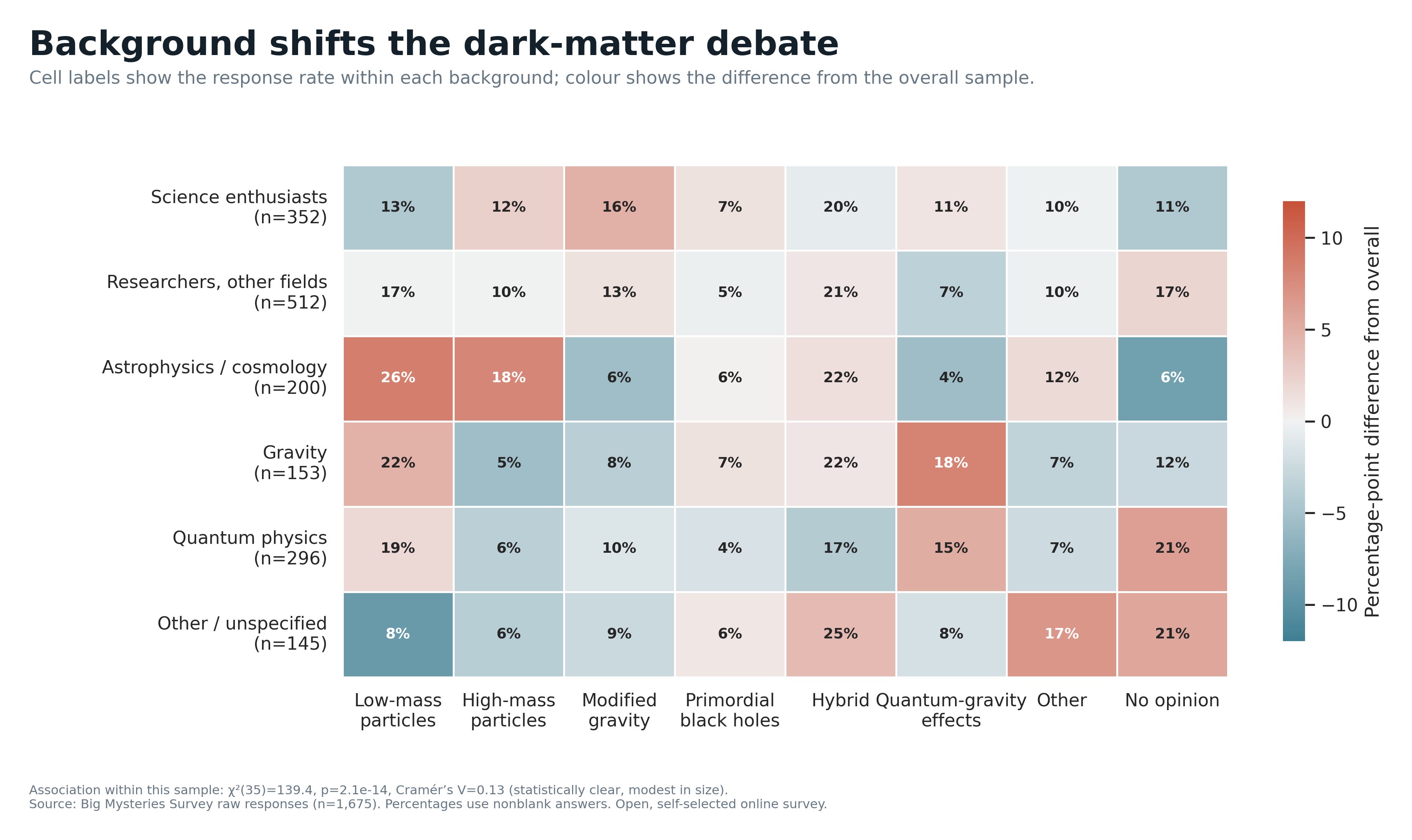
Analysis and visualisation by Prof Niayesh Afshordi.
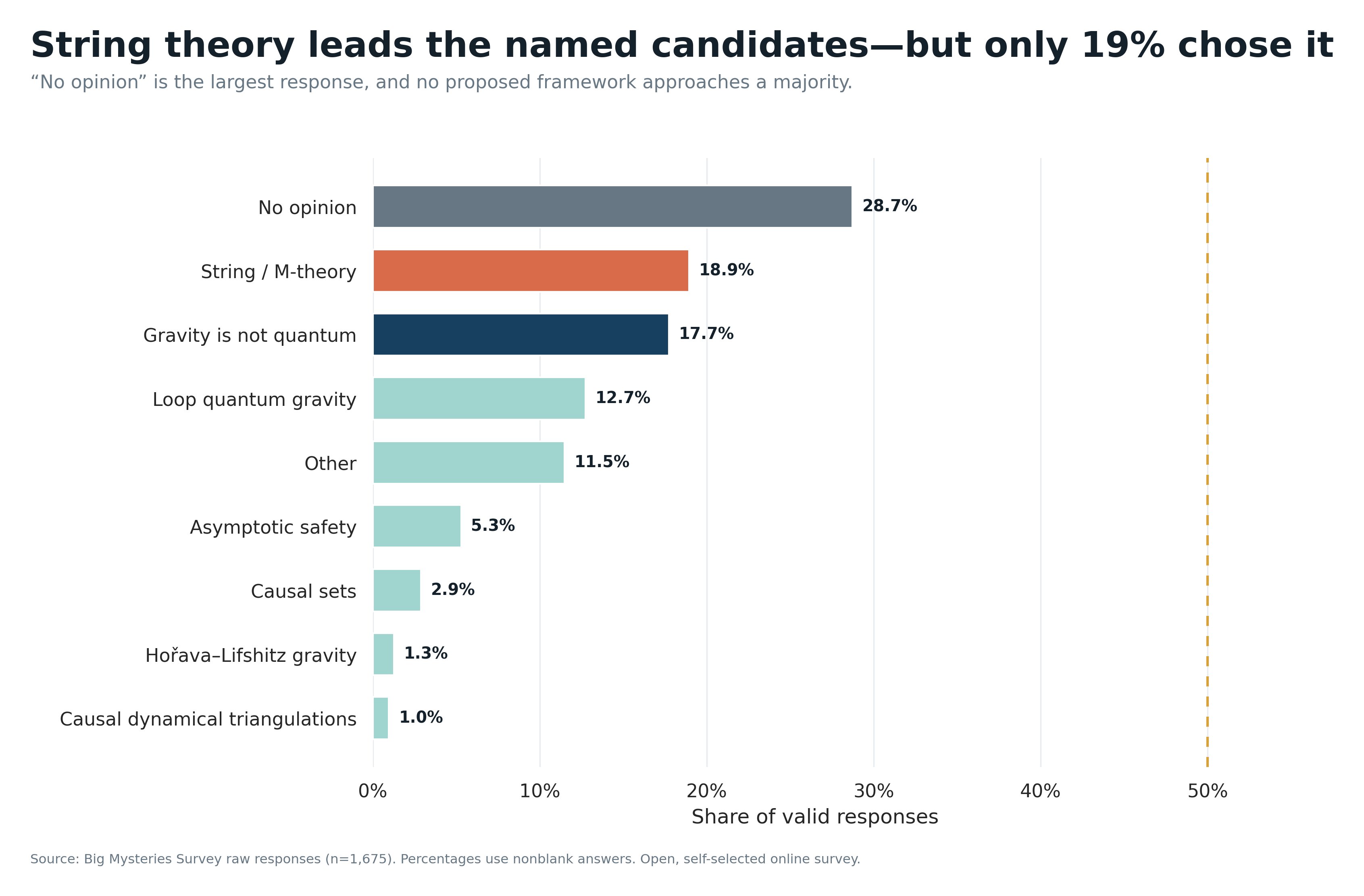
Analysis and visualisation by Prof Niayesh Afshordi.